
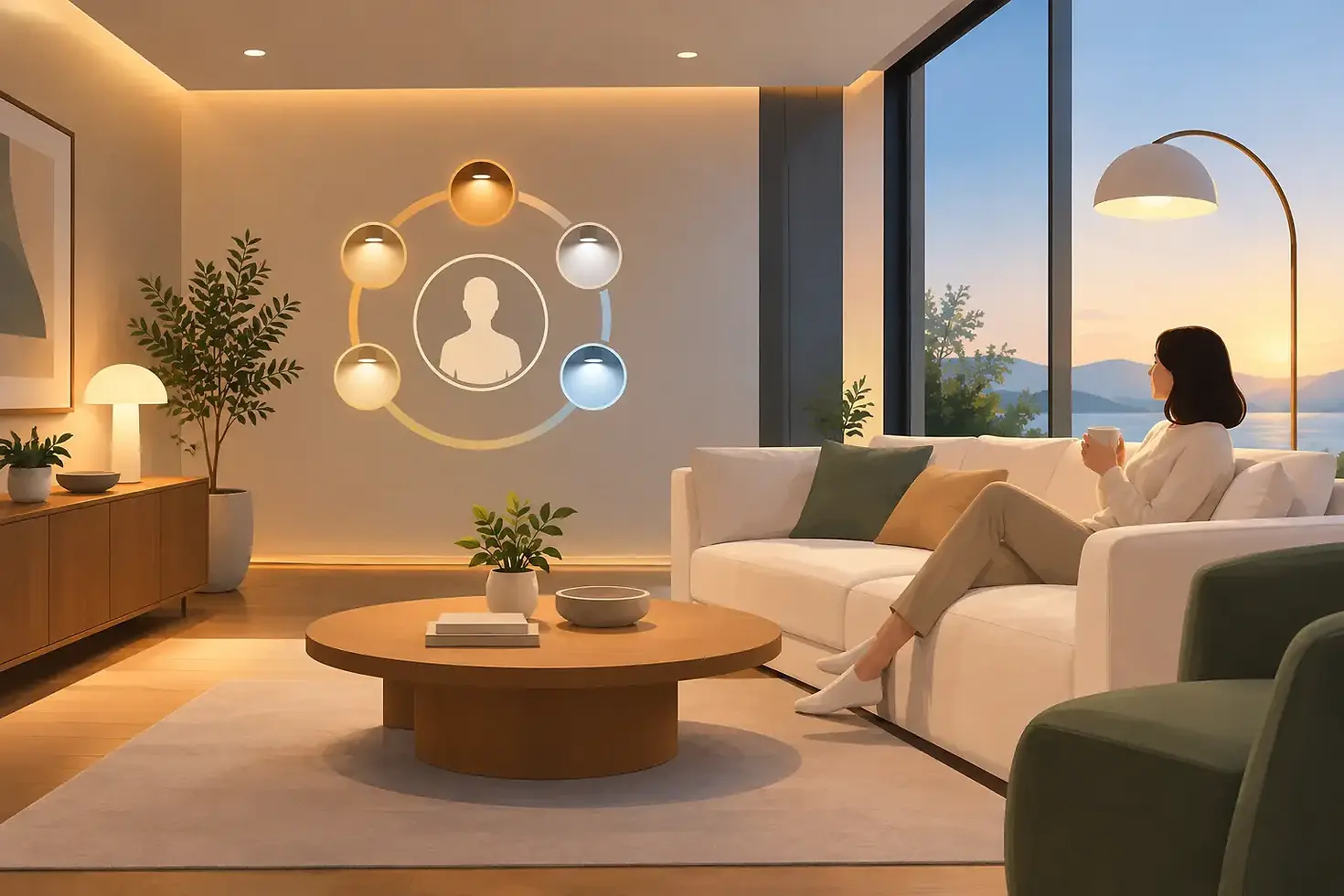
Human Centric Lighting Trends Shaping Fine Homes
A home can be beautifully furnished and still feel slightly wrong at 7:00 p.m. The reason is often light: a kitchen that remains too cool after sunset, a bedroom with bright controls that interrupt the wind-down routine, or a living room that has no convincing setting between work mode and entertaining. Human centric lighting trends address this gap by treating light as an active part of architecture, comfort, and daily rhythm rather than a static utility overhead.
For luxury residences and carefully considered commercial spaces, the appeal is not a novelty color-changing fixture. It is a composed lighting environment that supports the way a room is used, protects the design intent, and remains simple for occupants to control. The strongest projects combine high-quality architectural luminaires, thoughtful daylight management, and programming that feels natural rather than performative.
Human Centric Lighting Trends Moving Beyond Color Temperature
The market often reduces human-centric lighting to tunable white fixtures that shift from warm to cool. Tunable white is valuable, but it is only one tool. The broader approach considers intensity, distribution, contrast, glare, timing, color quality, and the relationship between electric light and daylight.
Morning light may be brighter and more neutral in spaces where people dress, prepare, or begin focused work. As evening approaches, light can become warmer, lower in level, and more layered. This supports a more comfortable visual transition at the end of the day, particularly when screens and bright task lighting already compete for attention.
The nuance matters. A residence does not need to mimic a laboratory schedule, and people do not follow identical routines. Seasonal changes, travel, shift work, entertaining, and personal preference all affect what feels appropriate. The goal is not to impose a rigid circadian program. It is to give the home or workplace a lighting language that aligns more closely with human activity and the available daylight.
Tunable white becomes architectural, not decorative
Early tunable lighting installations sometimes made the technology itself the focal point. Current luxury applications are more restrained. The light source is selected for excellent color rendering, consistency across fixtures, and smooth dimming at very low levels. The change in tone should be gradual enough that occupants notice the comfort, not the mechanism.
This has direct implications for specification. Decorative pendants, recessed downlights, cove lighting, millwork accents, and exterior-adjacent areas should be evaluated as a complete visual composition. Mixing fixtures with mismatched color quality or dimming behavior can undermine an otherwise sophisticated system. A beautiful stone surface, artwork, or custom finish deserves light that renders its material character faithfully throughout the day.
Layered Light Is the Foundation
Human-centered design begins with layers. Ambient light establishes a comfortable overall level. Task light serves reading, grooming, cooking, and focused work. Accent light gives architecture, art, texture, and landscape elements their presence. When all three layers are carefully balanced, a space can remain visually comfortable at lower overall light levels.
This is especially relevant in open-plan homes. One large room may need to support breakfast, homework, video calls, dinner, and late-evening conversation. A single circuit of recessed fixtures cannot serve every one of those moments elegantly. Thoughtful layers make it possible to illuminate the island for preparation while preserving a softer perimeter for guests, or to highlight art and architectural volume without washing every surface in light.
The trend is also changing how designers approach darkness. Not every corner needs equal brightness. Controlled shadow creates depth and calm, while precise illumination directs the eye to what matters. In high-end interiors, restraint often produces a more luxurious result than excessive fixture count.
Wellness Requires Better Daylight Coordination
Electric lighting has the greatest impact when it works with, rather than against, daylight. Motorized shading, window orientation, glazing performance, and room layout all influence the lighting plan. A bright west-facing great room presents different challenges than a north-facing study, and both should be considered early in the design process.
Automated shades can manage glare, protect furnishings, and temper solar heat gain while preserving a view. Paired with programmed lighting, they help rooms maintain an appropriate visual balance as daylight changes. The result is less manual adjustment and fewer moments when a screen becomes unreadable or a carefully designed room feels harsh.
There are trade-offs. Shades should not close so aggressively that occupants lose their connection to the outdoors, and automation should always allow graceful manual override. In hospitality and corporate environments, the approach must also account for operating hours, occupancy patterns, cleaning needs, and the brand experience expected in public-facing spaces.
Low-Level Evening Light Takes a More Prominent Role
One of the most practical human centric lighting trends is the renewed focus on low-level illumination after dark. Instead of relying on bright overhead fixtures for every nighttime need, designers are integrating discreet sources at stair treads, toe-kicks, corridors, vanity areas, and pathways.
These lights can provide orientation without fully waking the house. Warm, carefully shielded illumination is particularly effective for midnight trips to the kitchen or bath, when a bright ceiling light can feel abrupt. In larger estates, this approach also improves wayfinding for guests and staff while preserving the atmosphere of the architecture.
Low-level lighting must be placed with precision. A poorly aimed fixture can create visible dots, distracting reflections, or uncomfortable glare at floor level. Details such as fixture depth, lens quality, finish reflectance, and dimming range deserve the same attention as a statement chandelier.
Controls Are Becoming More Invisible
The best lighting control is available when needed and unobtrusive when it is not. Keypads with engraved, room-specific buttons remain valuable because they offer immediate, reliable access. At the same time, scenes can be activated through occupancy sensing, time schedules, mobile interfaces, voice control, and whole-property automation.
The trend is away from cluttered walls and toward fewer, more meaningful choices. Rather than asking a homeowner to manage individual circuits, a well-programmed system might offer Morning, Entertain, Dining, Relax, and Goodnight. Each scene coordinates multiple lighting layers and, when appropriate, shades and other connected systems.
Simplicity should not be confused with lack of control. A premium system should accommodate personal preferences without requiring a homeowner to become a programmer. It should also remain intelligible years later, when staff changes, a room is redesigned, or the family routine evolves. Clear documentation, disciplined panel design, and commissioning are essential to that long-term confidence.
Human Centric Lighting Trends Are Expanding Outdoors
The same thinking is extending into landscape and exterior architecture. Outdoor lighting is moving away from broad, indiscriminate brightness toward selective illumination that supports safety, arrival, entertaining, and visual drama.
Warm pathway lighting, restrained grazing on stone or specimen trees, and controlled pool-area illumination can make a property feel more inviting without overwhelming the nightscape. The objective is not to eliminate darkness. It is to make movement secure and the landscape legible while respecting neighboring properties and the natural environment.
Astronomical time clocks, occupancy logic, and scene control help exterior systems adapt through the evening. For residences with extensive grounds, security requirements must be addressed without turning the property into a floodlit perimeter. Coordinating architectural lighting, surveillance, gates, and landscape systems early produces a more polished result.
Specification and Commissioning Matter as Much as Fixtures
A human-centered lighting strategy can fail when products are chosen late or installed without proper calibration. Fixture output, beam spread, aiming, dimming compatibility, driver location, control protocols, and finish coordination all affect the final experience. So do the practical realities of construction: ceiling depth, millwork details, access for service, and electrical capacity.
Commissioning is where the design becomes lived experience. Scenes should be reviewed at different times of day, adjusted with furnishings in place, and tested by the people who will use the space. A setting that looks correct in an empty home may need refinement once art, rugs, reflective surfaces, and window treatments are installed.
Techlinea approaches this process as an integration exercise, bringing lighting design, controls, shading, and supporting infrastructure into alignment before complexity becomes costly. For architects, interior designers, and builders, that collaboration protects the design vision while giving clients a home that feels composed from the first morning through the last hour of the evening.
The most enduring choice is to plan light early enough that it can belong to the architecture. When the controls feel intuitive, the fixtures disappear into the details, and each room responds gracefully to real life, human-centric lighting stops being a trend and becomes part of how a property cares for the people within it.


Comments